
How to get your first 1,000 mobile app users
Work backwards from a useful first action. Test three ways to reach mobile app users, measure who comes back, and plan your first seven days.

Count people who finish the job your app promises. Find one place you can reach those people repeatedly, then check who returns before increasing your spend.
A running club already has a group chat. The organiser posts a route on Monday. By Saturday morning, “Where do we meet?” is buried under forty replies. If your mobile app keeps the next run in one place, you have a reason for someone to open it at a particular moment. That gives you a better starting point for finding your first 1,000 users than choosing between Instagram, ads and a launch directory.
Decide what earns a place in your first thousand
For the club app, count a new runner as activated when they open the correct upcoming run and save it. Opening a store listing, installing the app and signing in are earlier steps. Someone can do all three and still arrive at the wrong park. Write your own definition in a sentence that includes a person, an action and the outcome they came for.
Run through that action on a phone that has never used the app. Start at the invitation a newcomer will actually receive. After installation, can they find Saturday’s run without knowing the club’s exact name? If the invitation loses its destination during installation, give the runner a short club code and somewhere obvious to enter it. Test the whole trip again with a newcomer. The first mobile usability test guide gives you a way to watch without coaching.
Turn your definition into two screens you could show an organiser. In the Mingle event template, a visitor arrives at an invitation with Build my day and an empty plan. Suppose the promise in your announcement is “Keep the session you want to attend”. Merely opening this invitation tells you that the link worked. It still leaves the visitor with the original problem of remembering where to be.
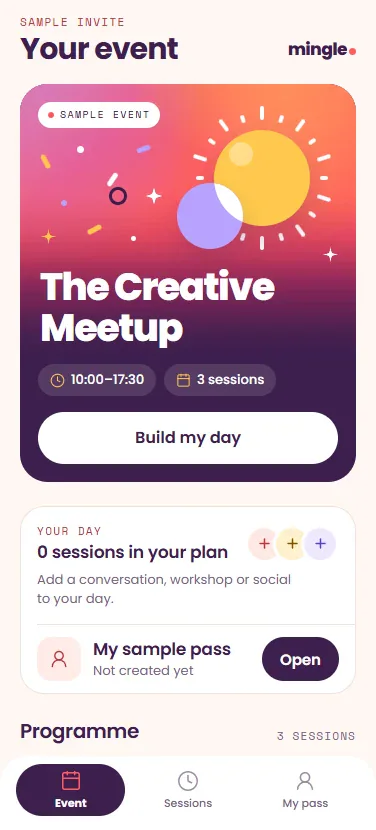
Before adding measurement, agree what finding the answer again looks like. Ask a volunteer to open the invitation and choose one session, then put the phone down. When they return to the invitation in the same preview session, can they tell you the talk and its time without reopening the whole programme? This is a practical test of the value stated in the announcement.
Try three ways to reach someone who needs the app
Ask one organiser for one trial. Find the club’s public organiser contact or the channel it designates for partnership requests. Send a specific, easy-to-decline invitation there. “Could we try a single link for Saturday’s route? I’ll set up the meeting point and start time. You can check the page first. If it’s useful, would you share it in the usual run announcement? I’d like to find out whether runners can find the start without asking you.” Let the organiser send the announcement through the channel runners already recognise.
Catch a question people already ask. With the organiser’s permission, add a small QR card at the finish table inviting runners to save next week’s meeting point. Use a separate source label for the card. Compare how many people reach the run and save it after the card versus the group announcement. The finish table reaches existing participants. The announcement can also reach a first-timer. A difference between them is a lead to investigate before you declare one channel better.
Give satisfied users something worth passing on. After a runner saves the run, offer the ordinary share action with a message they can edit. “I’m doing the river loop on Saturday. Here’s the meeting point if you want to join.” Put the invitation where it helps them make plans. Count friends who open that run and save it. A tap on Share alone cannot tell you whether an invitation was sent or helped anyone.
Read one cohort before you buy a bigger audience
Here is a hypothetical week. Across two consenting club trials, 160 visitors reach the invitation page, 80 people open the app for the first time, and 40 distinct runners save a run. Of those same 40, 16 come back and save the following week’s run. That is 50% from first open to activation and 40% returning among the activated runners. Use everyone who had a full chance to return in the denominator. Yesterday’s sign-ups have yet to get theirs.
At 40 new activations per comparable trial week, 25 such weeks would add up to 1,000 distinct activated runners if none were counted twice. That calculation describes cumulative activations. It tells you little about how many runners will use the app on any given Saturday. It also assumes a fresh audience each week. Posting the same announcement to the same club soon runs out of newcomers.
When opens are plentiful and saves are scarce, watch someone find the event after installation. When saves are healthy and returns fall, check that the club actually posted another run. If it did, ask one returning runner and one willing non-returner where they looked for the route. A cancelled run, an empty app and a perfectly good group chat call for different decisions.
The first capture below follows selection of the 10:00 talk. The second shows the event home afterwards with “10:00 · Ideas worth sharing” in the plan. These are real template interactions with session-local sample data. They illustrate what to observe in a trial. They do not measure a campaign. If your offer promises a reminder next week, give it a return test on a later day with the persisted production version before using that promise in recruitment.
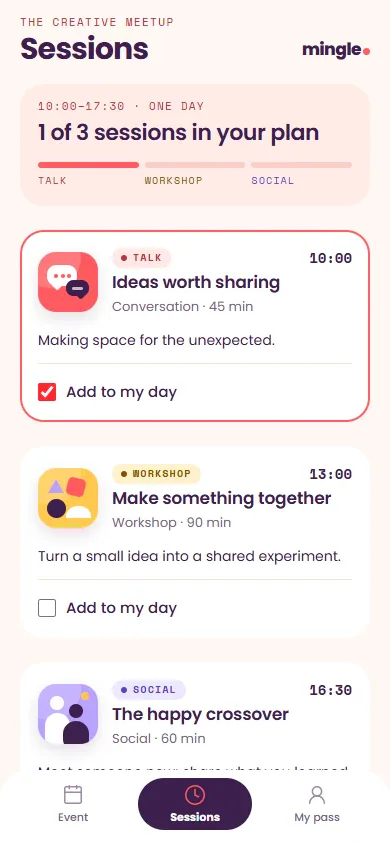
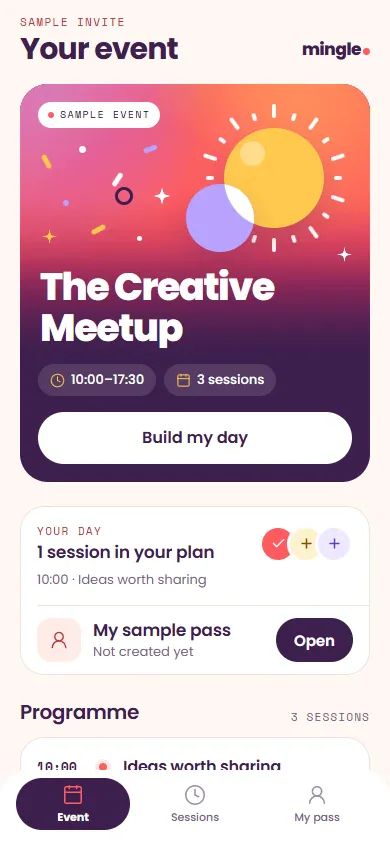
Count the visitor once when the intended session first appears in their plan. If they remove it and add it again while deciding, keep the repeated taps out of your new-user total. For a small organiser trial, also write down the question people still asked the organiser afterwards. “What time is the talk?” after someone successfully built a plan tells you something that an activation count alone will miss.
Keep your measurement small
Use a source label such as club-announcement or finish-table. Keep names, email addresses and a runner’s location out of the link. Count invitations opened, first runs saved and repeat saves with the minimum data your measurement needs. Explain collection plainly and honour people’s choices. If a store handoff loses the source, record it as unknown. Separately measured visits and first opens are directional counts unless you can reliably connect them.
A seven-day worksheet for your first trial
- Monday. Write “A new user has succeeded when ___.” Pick one event and one organiser who can check its details.
- Tuesday. Send the invitation above through the designated contact. Record their answer and the next event date.
- Wednesday. Prepare the invitation and QR card. Follow each on a fresh phone and write down where it lands.
- Thursday. Watch a first-time tester save the right run. Fix the first place they got stuck and repeat that journey.
- Friday. Have the organiser share the agreed announcement. Record its source label and the time it went out.
- Saturday. Try the finish-table card. Note how many people save the next run and which questions you hear in person.
- Sunday. Record visits, known first opens and activations for each source. Mark missing data as unknown. Book the following weekend’s retention check and choose one change to test.
You end the week with a decision you can act on. If newcomers save the run and return for the next one, ask the organiser to introduce you to one neighbouring club. If they cannot find the meeting point, spend the next session fixing that journey. You have a named audience to test with again.